- Center yourself by mindfully breathing in and out.
- Let yourself watch the procession of thoughts and feelings swirling by.
- If you get hooked by one, take a deep breath.
- Return to mindful breathing.
- Ask yourself, “What can I do?”
- At the end of your meditation, write in your journal. Without thinking, let the words flow. Follow the deep, authentic voice within you, casting light on new choices, revealing the next step on your journey.
- You always have a choice.
Welcome to my Blog
Then you're ready for your own personal Renaissance.
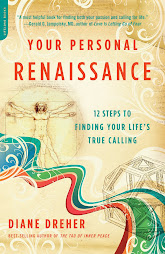
This blog offers insights from my books, including my new book, Your Personal Renaissance. .
I'll add posts on how to persevere in the light of personal, political, and planetary challenges--and I welcome your questions and comments.
Friday, May 10, 2013
Where are you going?
Wednesday, February 20, 2013
Whose Journey is This?
“Midway through the journey of my life,
I found myself lost in a dark wood.”
Dante Alighieri
I began my career inspired by the world’s greatest literature, determined to teach, write, and contribute to what Francis Bacon called “the advancement of knowledge.” Yet today I often find myself wrestling with shadows, rushing off to meetings, dealing with endless barrages of e-mail, spending more time on mundane chores than the ideals that once inspired me.
Does this sound familiar? Overwhelmed by demands and distractions, many of us feel lost on a journey that is not our own.
In the opening lines of the Divine Comedy, Dante writes that midway through the journey of his life he had lost his way. This realization led him on a pilgrimage through the depths of hell and finally to a vision of Paradise with “the love that lights the sun and the other stars.”
If you’ve been lost in a maze of demands, deadlines, and “shoulds,” you can find your way by practicing what St. Ignatius Loyola called Discernment. Beneath the surface noise of childhood conditioning, peer pressure, popular culture, and external demands is the quiet wisdom we can find by listening to our hearts.
Before making a choice, take time to listen. Often the first feeling you’ll notice is fear– fear of failure, fear of risk, rejection, loss, of not meeting others’ expectations, along with repressed emotions of hurt, defensiveness, anger, resentment—dark emotions Ignatius called “Desolation.” Yet beyond these painful emotions is “Consolation”–your deepest desires, guiding values, and feelings of love, joy, insight, understanding, gratitude, trust, openness, enthusiasm, creativity, inspiration, and peace. Consolation and Desolation are the two settings on your inner compass. As you move forward in life, they can help you find the right direction.
To practice Discernment now:
- Center yourself by breathing slowly and deeply.
- Think of a decision you need to make.
- Standing at the crossroads, see yourself making one choice, then the other.
- As you do so, listen to your heart. Which path leads to Consolation? Desolation?
- Take a deep breath and release it.
- Your inner guidance will come through–either now or later, as you go about your daily activities.
Diane
Saturday, December 8, 2012
Keeping the Flame Alive
As we’ve seen in previous posts, too much clutter in our lives snuffs out the flame, as do the incessant demands of “drama queens,” and conformity, which smothers our spirit. Sadly, today too many companies treat their employees like replaceable parts, valuing profit over persons. Obsessed with the bottom line, they downsize to increase “productivity,” squeezing more work out of a smaller work force, demanding that 40 people do the work of 60. In a desperate drive for innovation, one Silicon Valley corporation has even deprived employees of their offices. Removing all their personal effects—staplers, family photos, and coffee mugs—each day these people must find a new work space. Difficult external conditions can snuff out the flame, make us feel like victims of circumstance, with no control of our lives, not only destroying our creativity but making us doubt our sanity.
Yet as the Buddha realized, although painful conditions arise, suffering is optional. The power of mindful awareness can reignite the flame, transforming oppressive circumstance into liberation, creating new possibilities not only for ourselves but for all beings. Viktor Frankl discovered this power of the mind in a Nazi concentration camp, surviving to inspire millions with his book, Man’s Search for Meaning. Nelson Mandela emerged from 27 years in prison with a vision of the new South Africa, and Aung San Suu Kyi has kept the flame alive for democracy in Burma.
Like Frankl, Mandela, Aung San Suu Kyi, and centuries of other creative men and women, we are each keepers of the flame, the sacred source of our inspiration. Who knows the power and possibilities that lie within you?
Take a moment now to connect with this source. Focusing on your heart, ask yourself:
- What in my life snuffs out the flame? These are situations to avoid or transcend.
- What ignites and strengthens the flame? For many people it is contemplation, beauty, play, time spent in nature.
- Focus on your heart, feeling the flame burn brightly as you visualize what nurtures you.
- Feel this creative energy warm your heart, healing, nurturing, inspiring, flowing through your body and out your fingertips, preparing you to make your own creative contribution to the world.
Namaste,
Diane
Friday, July 20, 2012
What is Your Journey?
My friend Juan Velasco has said that writing and “reflecting on the different stages of your life, can dramatically improve your understanding of yourself and others.”
From earliest human history, throughout all world cultures, we have told our stories. Huddled around the campfire or sleeping under the stars, our ancestors passed down the stories that define us as human beings.
Joseph Campbell (1968) traced the mythic pattern of the hero’s journey—the courageous individual who leaves the known world for the great unknown, returning with a treasure to share with the larger community. Although some scholars see this as a masculine model of self-definition, I see the hero’s journey repeated in each of our lives. From the journeys of Odysseus to Dante’s Divine Comedy, the vision quests of Native Americans, to Thoreau living “deliberately” at Walden Pond to courageous individuals in recent times—Jacques Cousteau’s journeys to the ocean depths, Margaret Mead’s research in Samoa, Jane Goodall’s discoveries among the chimps in Africa—these journeys give us all a greater understanding of ourselves and our world.
The journey is ever present, yours and mine. Whenever we venture from the known to the great unknown—whether facing a new challenge or reaching out to explore a new opportunity, we take the hero’s journey, discovering valuable treasures along the way.
Take a few moments now to reflect on your own journey.
- When did you last leave your familiar path to enter the great unknown?
- What challenge did you face?
- What treasure did you discover?
- What did you learn about yourself?
Take a deep breath. Pause to give thanks for this experience as you recognize the deeper patterns of meaning in the ongoing journey of your life.
Reference
Campbell, J. (1968). The hero with a thousand faces. Princeton, N.J.: Princeton University Press. (Originally published 1949).
Tuesday, April 10, 2012
All The World's a Stage
Shakespeare wrote that “all the world’s a stage and all the men and women merely players” (Greenblatt, 1997). How we relate to the world around us shapes the daily drama of our lives. Are we mere puppets, dancing to someone else’s tune, second rate actors mouthing our lines—or jazz musicians, improvisational artists, actors who make the parts our own, creating a new reality in response to the world around us? Is our vision of reality static or dynamic?
Stanford psychologist Carol Dweck has made a powerful discovery, recognizing the degree to which our sense of self, our abilities, our success in life depend upon our “mindset.” People with what she calls a “set mindset” are stuck in the status quo, believing that their intelligence cannot be changed, while those with a “growth mindset” believe that their intelligence increases as they embrace new challenges in their lives.
Neuroscience research has shown that our brains develop throughout our lives, growing new neural connections in response to stimulation. So if you cannot ride a bicycle, use a new computer program, play a musical instrument, or do any other new task, regular practice will stimulate your brain to develop new connections. After days, perhaps weeks of clumsy attempts and awkward efforts, suddenly one day it all comes together: suddenly you can do it. Stimulated by all that effort, new brain connections have formed.
On a cultural level, the two mindsets of growth or status quo reach back to the earliest Renaissance concepts of vocation. Both Martin Luther and John Calvin believed that we were blessed with unique gifts and called to use them to serve God and our neighbors. But Luther saw the world as set, with the social order created by God—so that if your father was a butcher, a baker, or a glove maker, you were destined to follow his trade. But Calvin looked at the social injustice around him and concluded that God had nothing to do it: the social order was constructed by men. He believed we were called to discover our talents and use them to create new possibilities. With such a growth mindset, one glove maker’s son, William Shakespeare, found his calling on the London stage, writing plays that have inspired the world for centuries.
One view of life was dynamic, the other static; one led to conformity, the other to creativity and social change. These two social mindsets appear on many levels. The 18th century gave rise to two views of patriotism: 1) obedience to the status quo or 2) ideals that led to a new form of government, moving from monarchy to democracy, government of the people and the rule of law.
The world around us continually affirms a growth mindset. Look around you at the flowers of spring as they blossom and raise their heads to the sky. We can also find growth and set mindsets in our daily lives. Recently, when I questioned a longstanding policy at work, some people said “but we’ve always done it that way.” Yet just because we’ve done something for years doesn’t make it right or rule out better alternatives. If our country had followed a set mindset, there would be no progress, no airplanes, electricity, phones, or computers; women couldn’t vote and there would still be slaves. Progress—in science, art, politics, and life—flows from a growth mindset.
Now it’s your turn:
- Do you believe your intelligence and abilities are static or dynamic?
- Do you have a set or a growth mindset?
Whatever you have believed about yourself in the past, you really can change your intelligence and ability with practice--brain research has shown this is true. And by embracing a growth mindset, you can create greater possibilities within and around you.
Take a moment now to breathe in—realize that you are a living, growing unique individual, able to make a dynamic difference in your world, right here, right now.
References
Dweck, Carol. S. (2006). Mindset. New York, NY: Ballentine Books. Watch a video of Professor Dweck explaining her mindset research at http://www.youtube.com/watch?v=XHW9l_sCEyU
Wednesday, February 29, 2012
Creation or Stagnation?
Does your environment foster creation or stagnation? A recent study in Psychological Science has shown that while administrators and corporate CEOs talk a lot about creative innovation, they routinely block it. Threatened by the uncertainty of the creative process, they stifle the creative ideas of their people to maintain a predictable status quo: an absolute formula for stagnation (Mueller, Melwani, & Goncalo, 2012). And when they do promote change, these administrators over control. Instead of listening and learning from the people around them, they impose a new policy top-down, rewarding complicity, not creativity.
What our world needs now is not complicity but deep creativity, the courage to reach beyond the status quo for new solutions, new possibilities. This vision of creative leadership is affirmed in the ancient Chinese classic, the Tao Te Ching, which has inspired artists and innovative leaders for over twenty-five centuries. The Tao reminds us to look beyond divisive policies and limited definitions to learn from the wisdom of nature, the patterns within and around us:
The earth and sky cooperate
And the soft rain falls
Not by man’s laws
But by natural harmony.
When civilizations developed,
Definitions arose.
We know the part and not the whole.
Wisdom is seeing the patterns.
. . .
The powerful currents of Tao
Are like a river
Flowing homeward
To the sea.
(Tao Te Ching, chapter 32, from Dreher, 2000, pp. 242, 6, 198)
Change, in the Tao, is part of the natural cycle, and uncertainty the path to higher wisdom:
The way to greater light leads through the darkness.
Going ahead feels like falling back.
The even path seems rugged and hilly,
The highest power, a yielding valley.
The greatest virtue seems unreal,
And strength of character appears like folly.
Great space has no boundaries.
The greatest skill is developed gradually,
The greatest music rarely heard.
The great Tao is without form,
Elusive, undefinable,
Yet the source of all life.”
(Tao Te Ching, chapter 41, from Dreher, 2000, p. 213 and Dreher, 1996, p. 9)
As you face the challenges in your life, you can draw upon the wisdom of Tao. By pausing to recognize the larger patterns within and around you, you can transcend the status quo, experiencing the power and joy of new possibilities.
Take a moment now to breathe deeply. Know that you are part of the larger process. Embrace the infinite source of your creative power, right here, right now.
References
Dreher, D. (1996). The Tao of Personal Leadership. New York,NY: HarperCollins.
Dreher, D. (2000). The Tao of Inner Peace. New York,NY: Penguin Putnam.
Mueller, J. S., Melwani, S., & Goncalo, J. A. (2012). The bias against creativity: Why people desire but reject creative ideas. Psychological Science, 23, 13-17.
See Lao Tzu, Tao Te Ching. (2011). Gia-Fu Feng, Jane English, Toinette Lippe. (Trans.). New York, NY: Random House/Vintage for a beautiful translation of the Tao Te Ching with original Chinese calligraphy and evocative nature photography.
Wednesday, January 25, 2012
You CAN Make a Difference
As we create with words, images, and ideas, we participate in a powerful pattern of transformation. When we release our creations to the world, we never know how far they will travel, how many souls they will reach.
In 1848, a young man spent a night in jail for refusing to pay a poll tax, protesting against slavery and the Mexican-American War. The next morning, a friend paid his tax and he was released. A small action, unremarkable, perhaps. Yet this action inspired Henry David Thoreau to write Civil Disobedience, which later inspired Mahatma Gandhi’s campaign of nonviolence, liberating India from colonial rule; Martin Luther King’s campaign of nonviolence that began liberating African Americans from oppression and segregation; and countless other acts of nonviolence, large and small, that continue to liberate the human spirit.
We are all connected in the intricate pattern of life. Never doubt that your call to create is part of a process of transformation in which our individual actions ripple out to change the world.
Lately, I’ve been inspired by people in the Occupy Movement, raising their voices against corporate greed, injustice, and economic inequality. Now Maxina Ventura of Occupy Berkeley, has found a creative way many of us can connect in support and solidarity. She founded the “knit-in for the sit-in,” inviting people to knit at the Berkeley farmers’ market and send hand-knit hats, mittens, and scarves to help Occupy members keep warm this winter. So far, I’ve knitted four hats which have been sent to Occupy Wall Street, Tahrir Square, and Fukushima, Japan. Knitting these hats has become a kind of spiritual exercise, affirming my personal connection with this courageous campaign for change.
Because we are all connected, everything we do makes a difference, continuously creating the world we know. How can you make a difference in your own creative life? Following your heart will show you how. Together, we can create new possibilities for our world—right here and right now.
For More Information about the “knit-in,” see http://sanfrancisco.cbslocal.com/2011/11/26/crafters-organize-knit-in-in-solidarity-with-occupy-berkeley/. If you’d like to knit warm items for the Occupy Movement, you may send them to Occupy Berkeley, c/o Maxina Ventura, 2399 E. 14th St. No 24, San Leandro, CA 94577.